
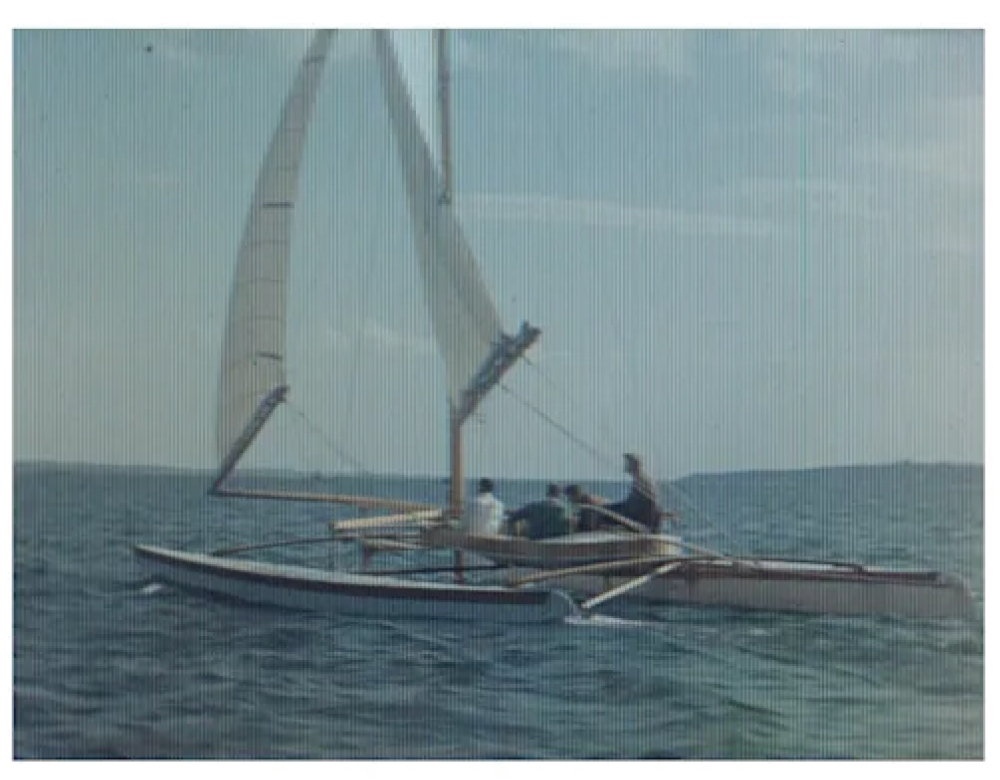
The library has recently acquired a unique film of Amaryllis II, a Herreshoff designed and built catamaran, filmed on rare Kodacolor film in September 1933. This is the only period motion picture known of a Herreshoff catamaran, and is one of the earliest amateur color films of any yacht. In the previous post we described the catamaran, its history and sailing trials. In this post we’ll look at the Kodacolor film itself – introduced in1928 it was the first color film available to amateurs – as well as the likely photographer who made this unique film, and the type of camera used.

The Film
Kodacolor film was introduced in 1928, the first color film made specifically for amateur film makers. Professional color movies had been made in the earlier 1920s on 35mm film stock, but Kodacolor was the first commercially available film made in the 16mm size used by amateurs. However it was not the simplest film to use – only cameras with a lens of very wide aperture could be used, specific color filters had to be placed in front of both the camera lens and the projector lens, certain projectors and screens had to be used, and the size of the projected image was small compared to that for black and white films – so when Kodachrome film was introduced in 1935, with none of the above drawbacks, Kodacolor rapidly disappeared from use.

Perhaps the most remarkable thing about Kodacolor film though, is that it is essentially black and white. Normal black and white Kodak film material was used, and on the opposite side from the emulsion hundreds of microscopic, cylindrical lenses, or lenticles, were embossed onto the film surface – hence Kodacolor is referred to as a lenticular film. The idea for this had originated with Frenchman Rodolphe Berthon around 1910, and unsuccessful attempts had been made by him and Albert Keller-Dorian in the early 1920s to produce a workable film. The rights to this process were purchased by Eastman Kodak in the mid 1920s though, and within a few years Kodacolor film was released to the public.

To use Kodacolor film, a three-color filter unit was placed over a standard f.1.9 lens. The colors of the filter – essentially red, green and blue – could in combination produce any other colors. The film was wound onto the camera in the usual way (although the emulsion was on the side furthest from the camera lens which was the opposite of black and white film), and as the filtered light passed through the lenticles it was focused onto the emulsion in three precise gradations of tone. Approximately 226 of the vertically-aligned lenticles covered the film frame13 and each lenticle focused the red, green and blue light separately into three, parallel vertical strips. The minute gaps between each lenticle are visible as the dark stripes running down the film frame. The film was processed in a similar manner to black and white film, and when projected through a matching three-color filter the three separate gradations would be converted back into the original color.

Kodacolor was first presented by Eastman Kodak at an event at George Eastman’s home in Rochester, attended by some of the most prominent scientists, businessmen and notable figures of the day, including Thomas Edison, General John Pershing, Frederick Ives (an early experimenter in color photography), Leo Baekeland (the inventor of Bakelite) E.F.W. Alexanderson (a radio and television engineer and inventor), the chairman of General Electric, the publisher of the New York Times, and others. The film became available for sale the next month, and a four-page ad in Movie Makers magazine trumpeted “Kodacolor is here! An amazing and spectacular achievement in the history of photography.”

To create a Kodacolor film you would need a camera with a wide, f.1.9 aperture lens (to compensate for the reduced amount of light coming through the color filters). This would initially have been a Cine-Kodak camera14, or within a few months a popular Bell & Howell Filmo camera as well. You would then have to purchase a Kodacolor filter for your camera ($15), another for your projector ($18), a special 16 1/2 x 22 inch aluminum finished projection screen ($25), and a roll of film ($6 for a 50ft roll) – totaling $64, about $1,000 today. There were three different projectors that you could use with the film, and two of these would need modification (between $40 and $75 – but considerably better than the $300 price of a new Model B, Series K projector). So, as with much of amateur movie making at this time, it was not an inexpensive hobby.


A drawback of using color filters in front of a lens is that it reduces the amount of light passing through, and this was one of the principal reasons15 Kodacolor film could only be shot with the lens wide open, and preferably outside, on bright days. Since the camera could not be stopped down or have the aperture reduced if the scene was too bright, a neutral density filter that would reduce the amount of light going through the lens would have to be placed over the filter. Additionally, when filming with an aperture wide open, the depth of field – the area that is in focus – is small, and the critical importance of accurate focusing was often mentioned in advertisements and articles about Kodacolor.
When projected, the image would have to pass through another filter, so a far brighter projector bulb than normal was needed, and a screen had to be used that was smaller than those frequently used for black and white film – 16 1/2 x 22 inches as opposed to screens almost twice the size – and one that was finished in aluminum to provide extra luminosity.

Improvements were made to Kodacolor film in 1932, when a “Super-Sensitive” version that worked better in less-bright light was introduced, and soon afterwards a new adjustable filter was introduced that admitted more light than the past filter. However, when Kodachrome16 film was introduced in 1935 it had none of the drawbacks of Kodacolor. The film could be used in any camera, shot at any exposure, and projected with any projector onto a screen as large as any other. Although Kodacolor apparently continued to be manufactured for a few more years, all advertisements for it in amateur magazines essentially disappear after May 1935.

At some point in the 1960s or 70s this film was acquired by George O’Day – the Olympic and America’s Cup sailor, boat manufacturer, and film maker – and was among the collection of films donated by his family to the IYRS Maritime Library in 2024. The metal can that contained this film was marked only “Catamaran” on its label, and there was nothing to indicate the significance of the contents. As part of the process of having the collection digitized, this reel was then scanned and digitized in the normal manner, providing the library with a black and white version to use as a basis for research.
We then discussed with John Tariot of Film Video Digital, in New Hampshire, who has been doing all of IYRS’s film digitization, the options for having lenticular film digitized, and decided that Colorlab, in Maryland, was the best choice to do this work. Thomas Aschenbach, Colorlab’s owner, has spent many years developing a proprietary software17specifically for lenticular films: after the film is scanned in the usual manner the software is able to recognize and separate the three individual strips of tone created by each lenticle, it translates them back into the color densities initially created by the filter, and then combines them to create the complete image.
A few final details in this story though, still center on the film material itself. Appearing along one edge of the film is a repeating pattern of an oval and a circle. For many years most of the major movie camera manufacturers differentiated their models with specific marks, perforations or shapes built into the film gate which then appear on the edge of the developed film, revealing what camera was used – in this case a Cine-Kodak Model BB.


The BB had been introduced in 1929 as a smaller, slightly less-expensive, and stylish alternative to the Model B – it was issued in blue, brown and gray as well as black. To allow for the smaller size though, it took only a 50’ reel of film, unlike the Model B which could also take a 100’ reel18. At the standard film speed of 16 frames per second, this meant that a 50’ reel of film would last for approximately only two minutes19. While it was sometimes convenient to have a shorter roll of film, allowing it to be sent off for processing sooner, in this case it probably was not, since for the five minutes of finished film of Amaryllis II the camera would have had to have been reloaded – on board Bubble – at least twice. Another point worth remembering is that movie cameras at this time had spring-driven motors which had to be rewound frequently: as suggested in the manual, about 20 half-turns were needed to fully wind this camera which would provide about 30 seconds of continuous filming, at which point the camera would have to be wound again.
Lastly, because of the unique way Kodacolor films were made, with the layer of minute lenticles lining one side, it was not possible to make a copy in the normal, darkroom manner. Aside from filming a projected image, with a fairly large loss of quality, there was no way to copy these films. So, unlike films in most other twentieth century formats, Kodacolor films are literally unique. They provide a vital record of the first color film making available to amateurs, recording the earliest attempts of the every-day movie maker to capture events important to him or her, in a completely new way.–FF
Footnotes:
12 Robert A. Mitchell, “Is Lenticulated Color-Film Practical?”, International Projectionist, October 1951 (written at a time when there was some consideration of lenticular film being encouraged for the professional market).
13 559 lenses per inch (25.4mm) as stated in “The Kodak Magazine”, September 1928. The 16mm film frame is 10.26mm wide, so ~226 per frame.
14 Cine-Kodak Model B. The Model BB was introduced in 1929, and the Cine-Kodak Model K was introduced in 1930. In 1929 the Model BB cost $140 (approximately $2,000 today).
15 To ensure that the light calibrated accurately on the film emulsion for the duration of the movie, the lens had to remain at the same aperture, or opening size, for the entire time.
16 Kodachrome was made with multiple layers, each responsive to different colored light, essentially on top of one another on the same film strip.
17 Kodacolor Decoding Software
18 The Model K, released in 1930, would also take both 50’ and 100’ reels.
19 16mm film has 40 frames per foot, so 2000 frames on a 50’ reel which, at 16fps, equals 2 minutes 5 seconds