
Shipwright, BROR TAMM: Polymath & Poet
POLYMATH (n): a person who knows a lot about many different subjects POET (n): a maker; one distinguished by imaginative power, insight, sensibility and facility of expression.
So effusive and brimming with superlatives is the whopping 11-page send-off to Bror Tamm written by Llewelyn Howland III (See WoodenBoat No.46, May/June 1982: “A Farewell to Bror Tamm”) it seems impossible that “Tammy”—as he was widely known– has not become a household name in the sailing community. A contemporary and frequent collaborator with L. Francis Herreshoff, Frank Paine, Irving Johnson, Henry Nevins, Starling Burgess, Clinton Crane, Philip Rhodes, Ray Hunt, Olin Stephens and Rod Stephens; his client list resembled a roll call of sailing’s foremost champions including Harold Vanderbilt who sought him out for his wide-ranging expertise, inventiveness and exemplary work ethic. Beyond the rarified air of the racing yacht arena, Tammy oversaw the construction of state-of-the-art military vessels, massive motor yachts, schooners and even Admiral Byrd hand-picked Tammy to build specialized “flying boat” hulls used for his expeditions.

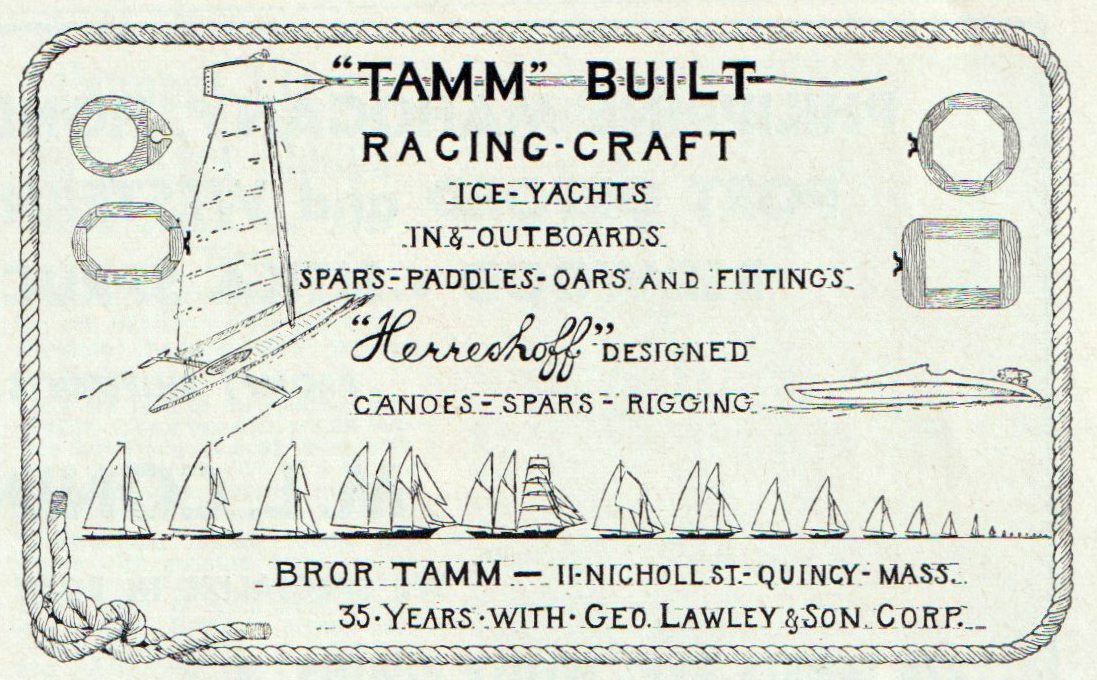
The Bror Tamm Archive within the IYRS Library Collection contains approximately 200 card folders holding magazine clippings, sketches and plans dating from 1907-1973 amassed by Tamm during his lifetime. Boxes of file folders (with titles written by Tamm himself) represent his lifelong curiosity and commitment to expanding his knowledge. The archive (still being cataloged) sheds light on the polymath’s wide-ranging areas of interest. Just a few of the folders that contain his original sketches are labeled: “Boom- Crutch”, “Tunnel Stems”, “Old- Fashioned Solid Spars”, “Mast Hoops”, “Steering Gear” as well as the “Sail Tracks” sketches above.
While deftly managing crews ranging in size from 800 (in peacetime) to 5000 (during WWII) men as foreman and superintendent of George Lawley & Son, Co. (Neponset, MA) from 1912 – 1962, he “laid down” (BT’s term for lofting) more than 260 yachts. These included VANITIE, HIGHLAND LIGHT, the 235’ motor yacht CAMARGO, and the great schooner MIGRANT while simultaneously supervising as many more through the building process.

An unrivaled expert in the arcane craft of mast-making, Tammy was also in charge of the construction and rigging of 170’+/- hollow wooden spars for both WHIRLWIND and YANKEE. Concurrently fabricating the sky-scraping J-Class masts, designed by L. Francis Herreshoff and Frank Paine respectively, required him to develop unique production methods for each of the two dissimilar spars whose shear sizes made the logistics of their individual constructions equally challenging.
“ No shipwright has had a greater capacity for understanding and appreciating the materials, human and otherwise, that were lent to his command.”
Llewelyn Howland III
It was with the greatest respect for the Herreshoff Mfg. Co., that Tamm deliberately chose to ply his skills at George Lawley & Son Co., where his work would not be micro- managed by Captain Nat in service to “the master’s creations.” With Tammy at the production helm, Lawley’s became widely-respected as a foreman’s yard that existed to serve the customer, not the reverse– this suited his clients down to the ground. Tamm eschewed reckless corner-cutting or questionable engineering admitting, “the line between experiment and folly is narrow indeed.” Each project he supervised benefited from his technical sophistication and superior work quality; they were also typically delivered promptly and on-budget.

No. 5153 Illustration from Lawley brochure, ca. 1930, showing the Lawley boatyard at the point of Port Norfolk., image source: Dorchester Atheneum
On Tamm’s first day of work at Lawely’s, April 15, 1912, the RMS TITANIC was reported sunk. The tragedy sent shockwaves throughout the shipbuilding industry and claimed the lives of a number of wealthy yachting clients. Tammy’s hours-old career with Lawley glanced off of an iceberg that day too when he was fired /quit from his first assignment with a deck-laying gang after a heated dispute with the job boss. He was subsequently rehired after arbitration by another job boss. The self-professed Corinthian sailor and man of principle was quoted:
“When some son of a bitch thinks he’s doing you a favor to let you work for him, that’s the time to get out.” ~ Bror Tamm
Of his extraordinary lofting technique, Howland wrote: “To me, this translation from the second dimension into a template for the third dimension is nearly as awesome to contemplate as the passage from the third to fourth dimension must be.”
How did this young, determined, Swedish-born, Danish immigrant to the U.S. come to be so confident? Like his contemporary colleagues, Francis Hereshoff and Frank Paine, Bror (Swedish for “brother) was the youngest of six children. Born into affluent families, all three enjoyed a childhood freedom that may have been the source of their shared unbridled imaginations. Sadly, Tamm’s fortunes shifted with the death of his father in 1904. Already passionate about sailing, he immersed himself in the study of all aspects of naval architecture mastering ships carpentry, mold-making and lofting. He worked in numerous Scandinavian shipbuilding concerns adding a plethora of skills to his expanding toolbox of talents.
“Tammy was by deposition an eclectic– at home with the language of ideas. All his life he was interested in new ideas, in the clash of ideas, in the ways old forms could be adapted to new purposes, new forms to old.”
Llewelyn Howland III
In addition to the extraordinary artistry, imagination, innovation and work ethic he brought to his prolific marine career; for his life-long pursuit of knowledge and excellence… Poet, Polymath & Shipwright Extraordinaire, BROR TAMM surely rates sailing household-name status.– SAS