
In mid June 1951 The Providence Journal ran a story about a strange sighting in Narragansett Bay:
“A rumor going the rounds at Newport is that John Nicholas Brown’s famous ocean-racing yawl, Bolero, has shrunk. At least a tiny Bolero, reduced from 73 to 20 feet, appeared recently near the Brown mooring off Halidon Hill.”

This miniature yacht, named Deb and a scaled-down combination of Sparkman & Stephens’s Bolero and Loki, had been built by Albert Lemos, long-time boatbuilder of Riverside, Rhode Island. She had been built from experience too, as Lemos had built nine vessels for Sparkman & Stephens between 1933 and 1949: including El Nido (1933), their first powerboat commission; Werdna (1935); Spookie (1937), Lemos’s favorite; and Loki (1948).
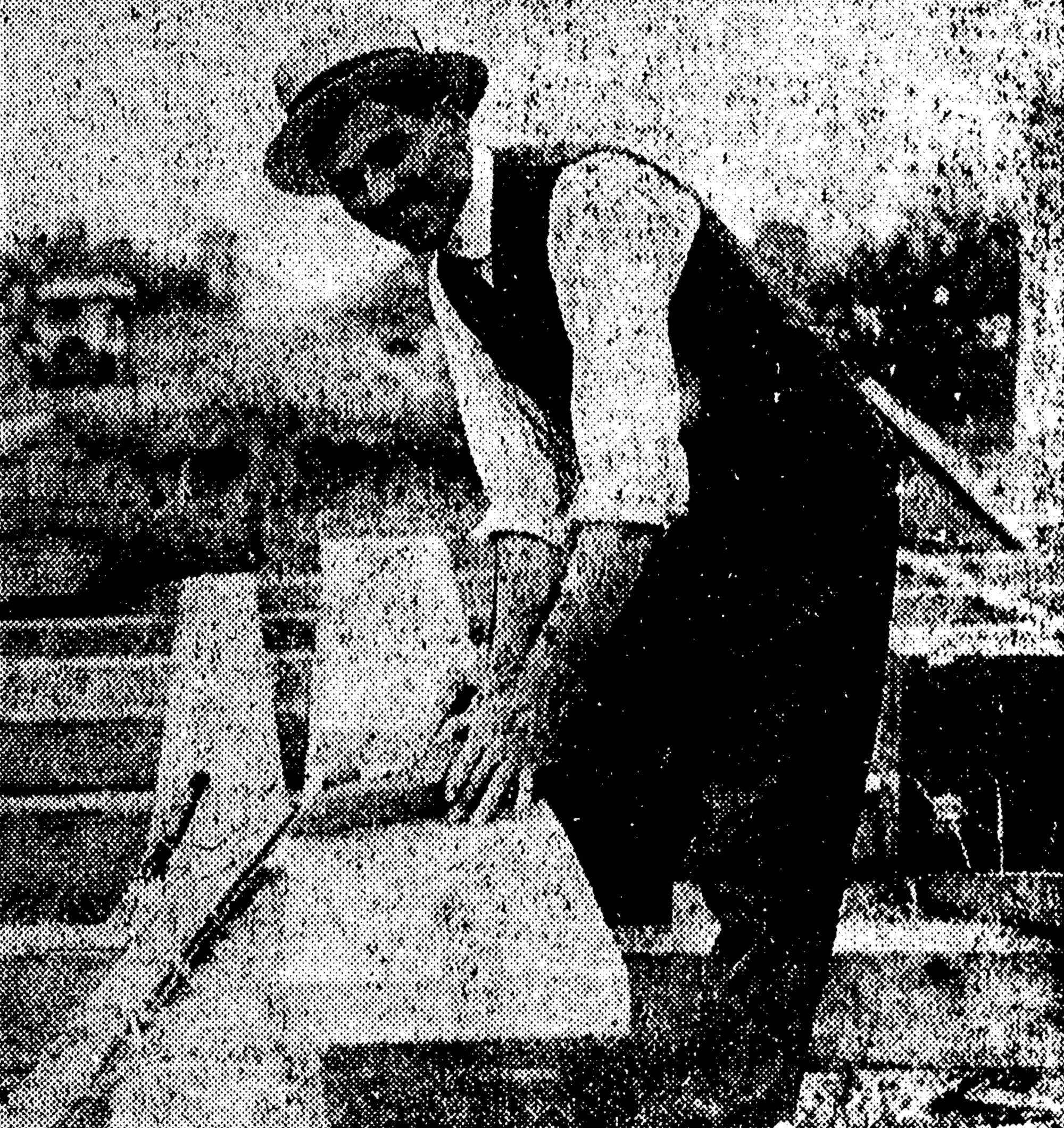
Albert Lemos (1883-1976) was born on the island of Faial, in the Azores. He had little formal schooling but by the age of 14 had built his first boat, a 16’ schooner-rigged skiff with a clipper bow, and he spent some years working as a ship’s carpenter on a ship sailing between the Azores and Portugal. At the age of 21 he married his wife Bernarda, and soon after they emigrated to the United States.

Settling in Fox Point, Providence, Lemos worked initially as a house carpenter however he soon returned to boatbuilding, and by 1906 had established a yard with his brother at the southern edge of East Providence, on Bullock Point in Riverside. Records describing the types of vessels he built in these early years are scant, however in 1910 he designed and built the 51’ steam yacht Maurence for a Walter W. Massie, president of the the Massie Wireless Company (according to Motor Boat magazine, she was to be “equipped with a complete wireless outfit”); in 1912 he designed and built Bedouin II, a 45 ‘ screw launch; and in 1916 was reported to be building a 150’ shallow-draught ferry or excursion boat, to bring passengers from Providence to Crescent Park amusement park in Riverside.
Through the 1920s he built a variety of boats (the partnership with his brother appears to have been relatively short-lived); a 26’ cabin cruiser in 1922; a 55’ power cruiser and another 42’ one in 1923; in 1925 he was mentioned in The Providence Journal as building “a miniature universal rule sloop only 12-feet overall” as well as two power yachts; and in 1929 he was reported to be building a 35’ cruiser as well as “making a yacht out of a 51-foot fishing boat that had been brought up from Florida.”
The change in opportunities for his business though, came in 1933 through his acquaintance with F. Emmons Alexander. Alexander was a yacht broker, and friend and sometimes competitor of Drake Sparkman’s. The young company of Sparkman & Stephens employed Alexander to start a brokerage office in Providence in May 1932 (moving to Boston in early 1934), and Lemos would have been one of the principal local builders he became familiar with. As Olin Stephens writes of Lemos in his autobiography:
“Emmons Alexander took me to meet him in the early thirties as a promising builder for the first powerboat for which I was individually responsible. He built the boat, El Nido, at a reasonable cost and very well. After that we were able to see that he did one new boat each year until the hurricane of 1938 completely washed out his yard”. And Stephens ends the paragraph, writing; “I cannot exaggerate the admiration I have always felt for Albert Lemos.”

El Nido was followed by Blue Heron in 1934, Werdna (1935), Domur II (1936), Spookie (1937), Azura (1938), White Heron (1940), Loki (1948) and Chance in 1949. Rod Stephens described the company’s involvement with Lemos to The Providence Journal in July 1951: “These boats were invariably beautifully built and beautifully finished, and the owner as well as the architect derived the greater pleasure in working with the yard while each craft was in production.”

Lemos’s yard actually fared better in the hurricane than Olin Stephens suggested, and better than many of his neighbors; about two-thirds of the yard was severely damaged, and some tools lost, but the railway was intact and the yard remained functional. However, perhaps at the thought of having to rebuild his business when he was in his mid fifties, he joined Herreshoff Manufacturing Co. in Bristol in November of that year, as supervisor of construction. The hurricane damage there had been repaired and business was reported to be carrying on as usual. About nine months later though, realizing that he preferred to run his own business, Lemos left Herreshoff and returned to his yard, which he had had maintained primarily as boat storage.
Over the next four years, reacting to the changed environment of the war years, Lemos built four trawlers for Atlantic Navigation Company of Boston. Each was a little over 100’ long, and he worked with a smaller crew of about half a dozen men only.


Returning to civilian work after the war, Lemos built Last Fling, a 50’ sport fishing boat designed by Edson and Charles Schock in 1946, and Comet (later Marluva) designed by Sidney DeWolf Herreshoff the following year. The two final Sparkman and Stephens commissions followed in the final years of the decade, as well as a prototype of the 24’ Raven class sloop, and Deb, his miniature Bolero/Loki.
However, in 1953 Lemos sold the yard to Godfrey “Unk” Allen, his foreman, and Carl Petersen, a former employee. The yard had two sheds, one for construction and the other a machine shop, and could handle 70 boats 30’ long or smaller for storage. The Lemos yard had been in business for 47 years, and was recognized in the press at the time as “the oldest under continuous operation by one builder in Rhode Island.”
Although retired, Lemos was not done as a boat builder. Over the next 15 years, working in the basement of his Riverside home, he built, sailed, and sold a new boat every few years until, in 1971, he retired again, to Camden, Maine.

For an article in The PROVIDENCE JOURNAL in March 1960, Lemos shared some thoughts about boat building:
‘From the beginning, Lemos has operated under a simply theory: “A good man doesn’t need a lot of tools.” In his cellar workshop today, Lemos has few tools and most of them, like the wooden planes, are old-timers. “Once a man came to me looking for a job,” he said, “and carrying three big boxes in his arms. I said ‘What are those?’ and he said, ‘They’re tools.’ I told him we didn’t have any openings. If he had had one little box of tools, I would have hired him and he probably would have been all right.”‘
Photos & Illustrations:
The Rhode Island Boat Builders Project:
The Rhode Island Boat Builders Project will bring to light the stories of boat builders across the state, from the eighteenth century until now. New research on different builders will be posted to this blog every few months, and we welcome additional information or insights. Francis Frost, IYRS Maritime Library. #RIBoatBuilders