
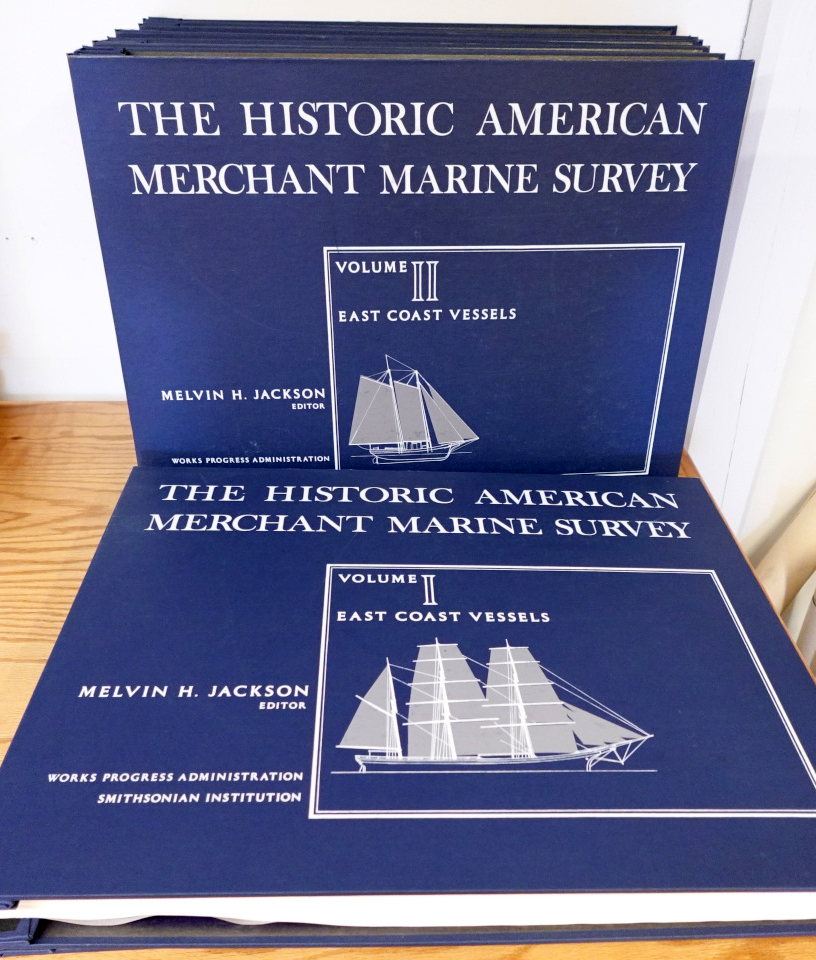
The library has recently received a generous donation of “The Historic American Merchant Marine Survey”, seven volumes, published in 1983 in a limited edition, consisting of plans and photographs of old working vessels compiled under the auspices of the Works Progress Administration in the 1930s.
Originally the idea of Eric Steinlein, a young naval architect and historian, and intended only as a way to record vanishing watercraft on Chesapeake Bay, once he approached the WPA with the idea it became a project national in scope (although not completed as planned) – four volumes cover east coast vessels of all sizes from Maine to Florida, two volumes cover the west coast, and one the Great Lakes.

Steinlein’s proposal for this national survey of old or vanishing watercraft, to be carried out by unemployed shipyard and boatyard workers, was approved, and work began officially in March 1936. Unfortunately, the project ended only about a year and a half later, far sooner than intended, however these seven volumes show the plans, details, and in many cases photographs, of hundreds of working boats of various types, all printed on large, fold-out sheets.
In a letter Steinlein wrote to President Roosevelt at the time the project was being wound down in mid-1937, printed in the introduction to this work, he sums up what he felt had been achieved: “[This project’s] purpose was to preserve, by means of measured drawings, photographs, and written reports, the technical history of the development of the American merchant marine. This it has done with a good measure of success. There is now in the Watercraft Collection of the [Smithsonian] Museum a file of technical information on American craft which, small as it is, is probably the most comprehensive and valuable thing of its sort ever done.”
Steinlein finishes his comments to this edition, written in 1977, with these thoughts:
“In my 70-odd years, I have seen the elimination, at an ever-increasing rate, of trades and crafts that for generations have given to their practitioners that sense of worth and dignity that makes us human and capable of self-government. The division of labor has reached the point of diminishing returns: the products of dehumanized labor are no longer reliable, and we are losing the ability to tell the shoddy from the real–
“The best function of a museum may be the preservation of the tools and products of the past as proof that the tool-using naked ape once had skills and arts and aspired to humanness.”
Eric Steinlein